
Cadernos de desenho
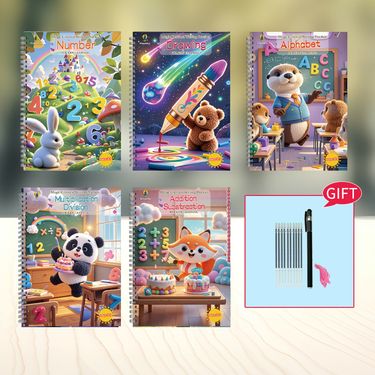
Conjunto de livros de prática de groove infantil - livro de exercícios 5 em 1 de alfabeto, números, matemática e desenho com caneta e empunhadura (habilidades de pré-escrita, aprimoramento da caligrafia)

Livro de colorir Jardim Secreto Pintura Infantil DIY Grafite Versão em Inglês Floresta Descompressiva para Colorir Adultos
The Creative Reset: How One Notebook Transforms Your Daily Routine
You know the feeling. You sit down to draw, full of inspiration, and then you realise you can't find a clean page. The sketchbook you have is half-filled with abandoned doodles, the paper is too thin for your marker pens, and the spiral binding is digging into your wrist. The frustration kills the creative spark before it even catches. That's the real enemy of creativity—not lack of talent, but bad tools. The right drawing notebooks don't just hold your ideas; they invite them. They make the act of creating so effortless that you actually do it. Here's how to build a creative routine that works, starting with the tool in your hand.
The Morning Pages: Warm Up Your Hand
Every creative professional knows the value of a warm-up. You wouldn't run a marathon without stretching first. Why start a drawing session cold? The perfect tool for this is a sketch pad spiral bound in a small, portable size—A5 or pocket-sized. The spiral binding means it lays flat on any surface: a cafe table, a train seat, your knee. Use it for three minutes every morning. Doodle. Scribble. Draw circles and lines. Let your hand move without judgment. The low stakes of a small, inexpensive pad remove the pressure to create something "good." You're just warming up the neural pathways between your eyes and your hand. By the time you turn to your main sketchbook, your muscles are loose, your mind is quiet, and the ideas flow without resistance. Pair your creative morning with a comfortable Women's Underwear choice for a feel-good start to your day.
The Main Event: Your Serious Sketchbook
For your important work—the pieces you intend to develop, the studies you want to keep, the projects that matter—you need a hardcover sketchbook that treats your work with respect. The hard cover protects the pages in your bag. The sewn binding means pages won't fall out after months of use. And the heavyweight paper (at least 120gsm) handles pencil, pen, and light washes without bleeding through. This is your creative laboratory. Use it for figure studies, landscape sketches, composition experiments. The ritual of opening a quality sketchbook signals to your brain: this is serious, this is important, this is worth my full attention. Keep it on your desk, open to a fresh page, so you can capture ideas the moment they arrive. Maintain your posture during long drawing sessions with Bras that offer the support you need.
The Portable Studio: Always Ready to Capture
The biggest enemy of creativity is "I'll remember that idea later." You won't. You'll be in the shower, on the bus, waiting for coffee, and a brilliant composition will flash through your mind. By the time you find a piece of paper, it's gone. The solution is a blank notebook for drawing in a size that fits any bag or pocket. A5 is the sweet spot—large enough to work in comfortably, small enough to carry everywhere. The key is that it's always with you. Not "in the car." Not "on the desk." In your bag. Everywhere. When an idea strikes, you pull it out and capture it in seconds. A quick thumbnail sketch, a written note, a rough layout. The act of capturing frees your mind to generate the next idea. This notebook is your external brain, always ready to receive.
The Digital Detox: Unplug to Create
Here's a routine worth adopting: one hour of screen-free sketching per week. No phone. No tablet. No digital distractions. Just you, a pencil, and a drawing pad with thick pages that can handle erasing and reworking. The physical feedback of pencil on paper—the texture, the resistance, the sound—is something no screen can replicate. It grounds you in the present moment, forcing you to slow down and observe. Use this hour for observational drawing: a still life on your kitchen counter, a plant on your windowsill, your sleeping cat. The goal isn't a masterpiece. The goal is the process—the meditative repetition of looking, understanding, and translating onto paper. This is the routine that builds skill, patience, and a deeper connection to your craft. Keep your hands warm and nimble with Women's Gloves during outdoor sketching sessions.
The Cleanup System: Never Lose a Page
The final piece of the routine is organisation. Nothing kills momentum faster than a pile of loose sketches you can never find when you need them. A spiral notebook drawing with perforated pages solves this. Use the notebook for ideation and rough work. When a sketch feels finished, tear it out along the perforation and file it in a clear folder organised by date or project. The notebook becomes a continuous stream of ideas; the folder becomes your curated archive. Six months from now, when you're looking for inspiration, you'll flip through that folder and find gold.
The Routine in Practice
Here's your simplified creative workflow:
- Morning warm-up — Small spiral pad, 3 minutes, no judgment
- Main session — Hardbound quality sketchbook, focused work
- On-the-go capture — Pocket-sized blank notebook, always in your bag
- Weekly analog hour — Thick paper, pencil only, no screens
- Monthly archive — Perforated pages, tear and file
That's it. Five steps. One set of drawing notebooks that work together to catch every idea, develop every skill, and build a consistent creative practice. The right tools don't just help you draw better. They help you draw more. And that's the real secret to improvement.
 4.4 de 5 com base em 9,249 avaliações